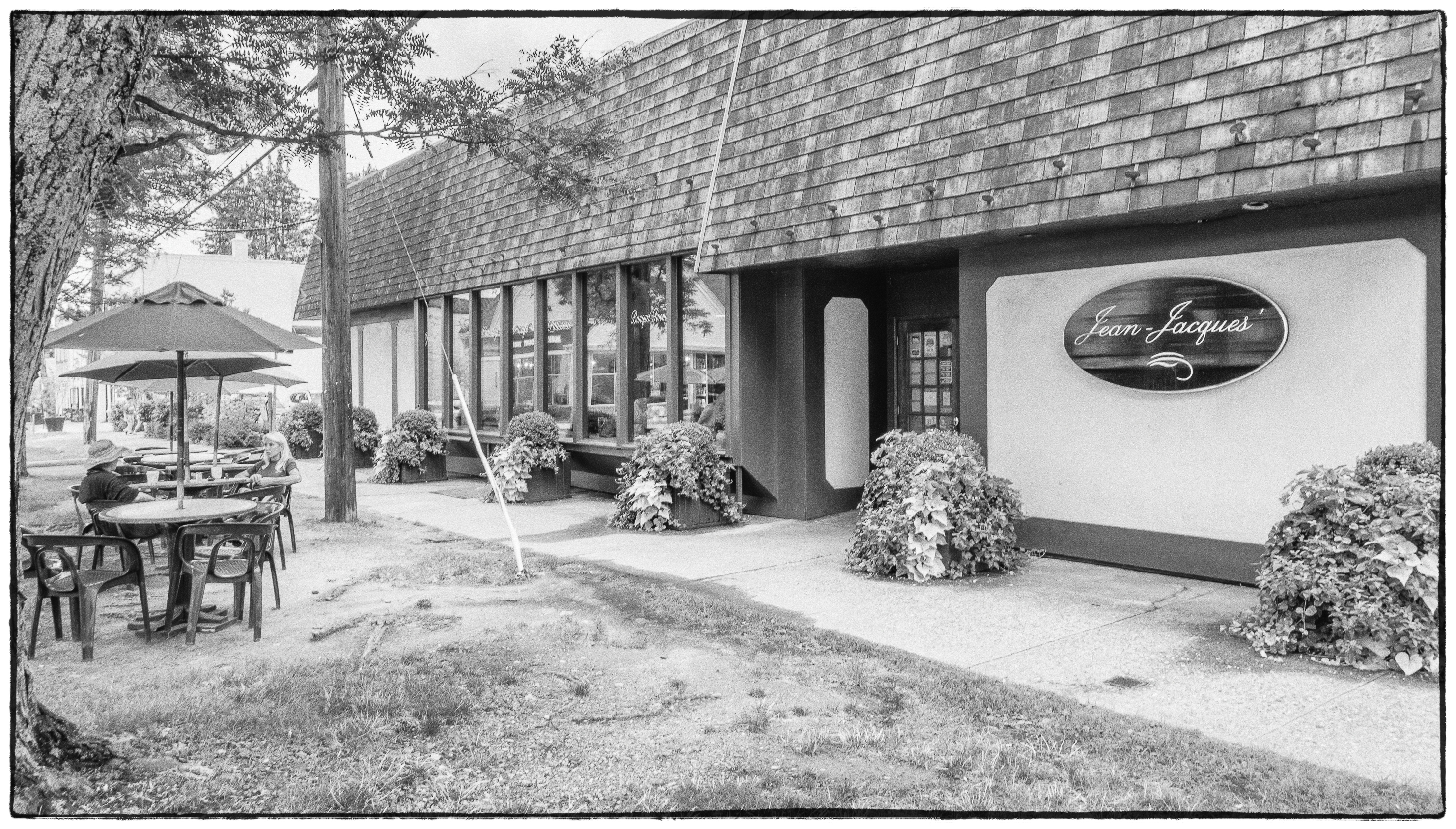
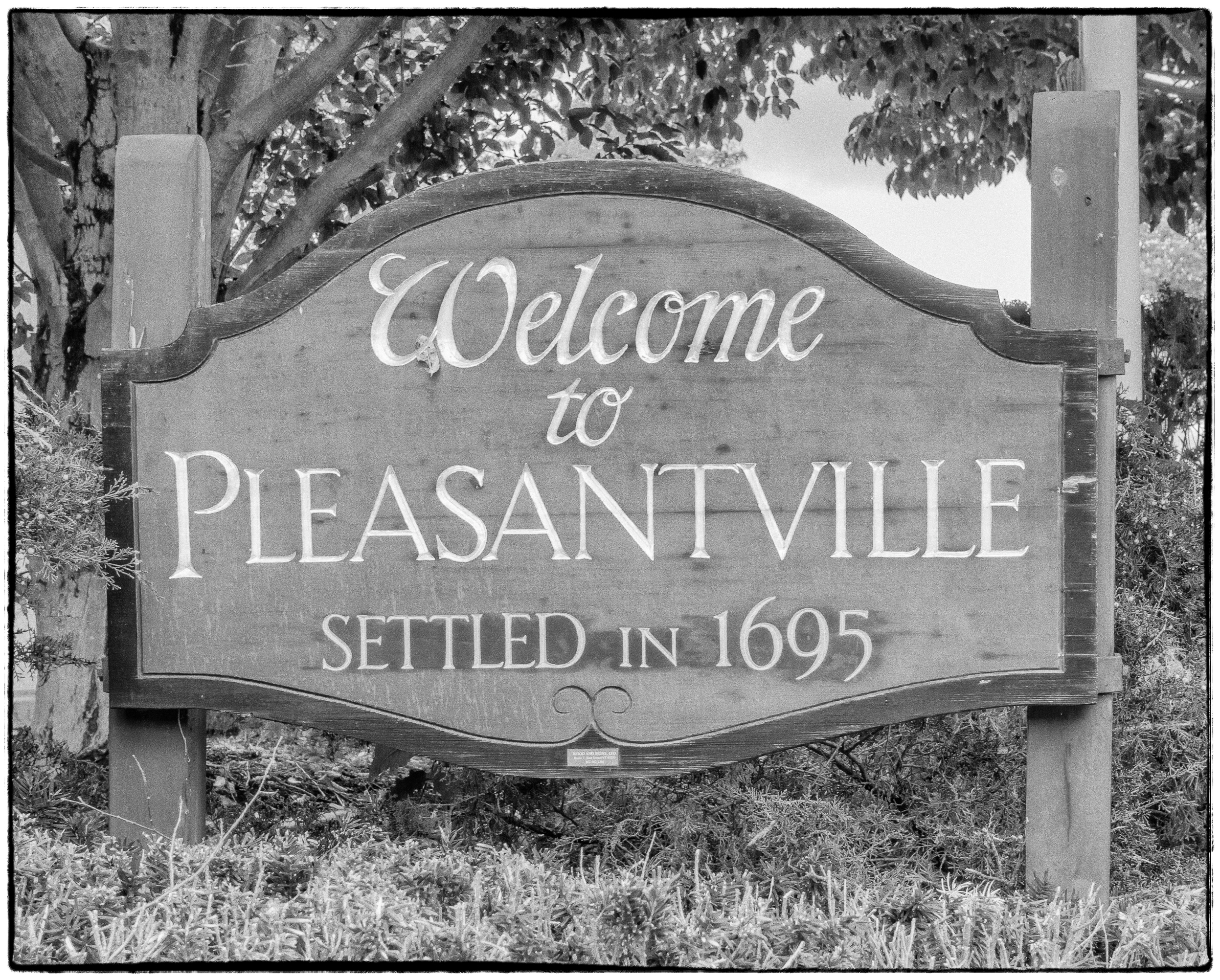
I’ve been to Pleasantville many times, but apart from one short walk around the station (See: Chairs at Pleasantville Station) I’ve never taken the time to walk through it and see what I could find. My wife was at her dance class and I was thinking about somewhere different to go for a change and it occurred to me that Pleasantville was nearby, so off I went.
The settlement of Pleasantville dates back to an Iroquois tribe, who raised corn there and established trading routes crossing through the present-day village before the arrival of Europeans. French Huguenot Isaac See settled here as an agent for Dutch landowner Frederick Philipse in 1695, beginning the modern history of Pleasantville.
By the time of the American Revolution, the population of the growing settlement comprised English, Dutch, and Quakers, most of whom were tenant farmers. During the Revolution, this area was part of the Neutral Ground, where there were conflicting loyalties among the settlers. British spy Major John André passed through present-Pleasantville carrying information from Benedict Arnold at Fort Clinton to the British in New York City. André lost his bearings near the present-day corner of Bedford Road and Choate Lane and was captured. The capture of André is often cited as a key factor in the ultimate victory of the American forces.
As the area’s population grew in the early 19th century, the settlement was called Clark’s Corners, referring to property owned by Henry Clark at the intersection of Broadway and Bedford Road. This area was the village’s original commercial center. In the 1820s, the newly appointed postmaster, Henry Romer, was directed by the Postmaster General’s office in Washington, D.C., to give a name to the post office planned here. Romer’s proposed name, Clarksville, was rejected because another New York post office already had the name. His second choice, Pleasantville, was accepted, and the Pleasantville Post Office opened on February 29, 1828.
A significant change in the development of Pleasantville came with the arrival of the New York Central Railroad and New York and Harlem Railroad in 1846. In the following year, a train station was built near the present corner of Bedford Road and Wheeler Avenue, and as a result the commercial center of Pleasantville shifted to its current location. The older business district at Bedford Road and Broadway is today called the Old Village. The railroad offered a speedier and more frequent connection with New York City—only 70 minutes away by rail, compared with a five-hour overland journey by stagecoach or a two-hour steamboat trip down the Hudson River. The present-day train station, which currently houses a restaurant, was built in 1905 and was moved to its present location in the 1950s to accommodate the lowering of the tracks below grade. Before the addition of the now heavily trafficked station, commuters working in New York City and lower Westchester County were forced to rely on rides from Marc Damon, now famous in Pleasantville for being “The Friendly Coachman”.
According to several sources, Pleasantville was a stop on the Underground Railroad, a network of safe houses for escaped slaves from the South on their way to freedom in the north.
The latter half of the 19th century was a time of rapid growth in Pleasantville. By the 1870s, there were four shoemaking businesses, a shirtmaking business, and a pickle factory. The first newspaper to serve the village, The Pleasantville Pioneer, was launched at about 1886. The village’s numerous small farms and orchards began to be subdivided for a wave of solid foursquare and Victorian houses built for a growing middle class. The 1890s saw the establishment of a police department, volunteer fire department, and a library system. Pleasantville was incorporated as a village on March 16, 1897.
In the following years, Pleasantville quickly developed into a modern suburb of New York, with a large number of workers commuting between the village and the metropolis on what is now the Metro-North Railroad’s Harlem Line. During the first two decades of the 20th century, roads were paved for the first time, water mains were installed, and electrical wires brought power to the village’s houses. Other improvements during the first half of the 20th century include the construction of Soldiers and Sailors Field in 1909, the Saw Mill River Parkway in 1924, the Rome Theater in 1925, Memorial Plaza in 1930, Parkway Field in 1930, and Nannahagen Park in 1937 (the adjacent village pool was completed two years later). By the time of World War II, the village had taken on the appearance that it bears today.
Pleasantville merits interest for its literary history. Playwright Lillian Hellman (The Children’s Hour, The Little Foxes) bought Hardscrabble Farm on the western outskirts of Pleasantville and lived there in the 1940s and 1950s. For many years author Dashiell Hammett (The Thin Man, The Maltese Falcon), with whom Hellman was romantically involved, lived and worked at Hardscrabble Farm. DeWitt Wallace and Lila Bell Wallace, co-founders of Reader’s Digest, made Pleasantville their headquarters in 1922, using a converted garage and pony shed on Eastview Avenue as their office and later building a home and larger office space on adjacent property. Subsequently, the Digest held office space in several buildings throughout Pleasantville, including the present-day Village Hall at Bedford Road and Wheeler Avenue and, diagonally opposite, the bank building currently occupied by Chase. Reader’s Digest moved its headquarters to nearby Chappaqua in 1939, but retained its Pleasantville post office box, thus making the name of the village familiar to millions of Reader’s Digest subscribers around the world. Pleasantville is also the home of Joseph Wallace, writer of the novel Diamond Ruby. Today Pleasantville is home to many novelists, editors, and writers, who find its easygoing charm and proximity to New York an attractive combination.
Pleasantville’s reputation as a cultural center was enhanced in 2001 with the opening of the nonprofit Jacob Burns Film Center in the landmark Rome Theater, a Spanish mission-style building and one of the first movie theaters in Westchester County. The Burns Center is dedicated to presenting independent, documentary, and world cinema. Guest speakers at the Burns Center have included Jerry Lewis, Woody Allen, Jonathan Demme, Robert Klein, Oliver Stone, Stephen King, Rob Lowe and numerous other notable filmmakers and actors.
Taken with a Sony RX100 M3.